Key Types of Manufacturing Defects in Glass Containers
Glass container defects originate from different stages of production, including melting,
forming,
cooling, and handling. While some defects are purely cosmetic, others directly compromise
structural
integrity and long-term durability.
From a manufacturing perspective, the most critical defects can be grouped into four categories:
internal
stress, inclusions such as air bubbles, geometric inconsistencies like uneven thickness, and
surface
micro-damage. Each of these defects introduces localized weaknesses that can evolve into failure
points
during use.
Understanding these defect types is essential not only for manufacturers aiming to improve
quality control,
but also for buyers who want to reduce breakage rates, minimize returns, and ensure product
safety in
demanding environments such as ovens, microwaves, and transportation systems.
In the following sections, we will break down each defect type, explain how it forms, and
analyze its impact
on real-world performance.
3.1 Internal Stress (Residual Stress)
Internal stress, also known as residual stress, is one of the most critical and dangerous defects in glass
manufacturing. It forms when different regions inside the glass cool at different rates during the transition from
molten to solid state.
Because glass is a poor thermal conductor, the outer surface cools and solidifies much faster than the inner
core. As the inner layer continues to contract while being constrained by the already rigid outer shell,
tensile stress becomes trapped within the structure.
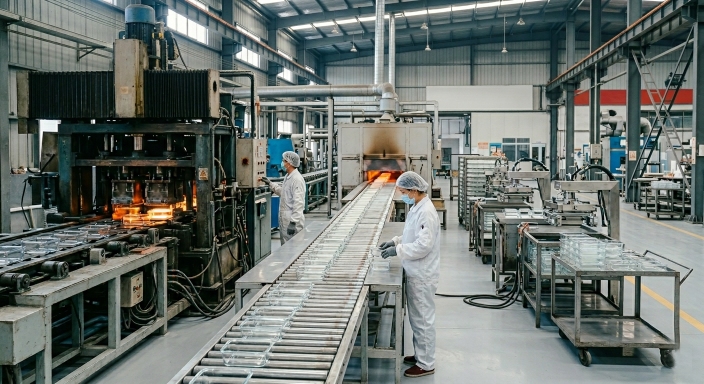
The only effective way to eliminate this stress is through a controlled annealing process, where the glass
is
reheated to a specific temperature range and cooled slowly to allow molecular relaxation. If this process is
rushed or uneven, significant stress remains locked inside the material.
Impact on durability:
- Sudden and unpredictable breakage during heating
- High sensitivity to temperature differences
- Failure without visible warning signs
In real-world applications, residual stress is a primary cause of glass containers “exploding” in ovens or
microwaves, even when used within recommended temperature limits.
3.2 Air Bubbles (Inclusions)
Air bubbles, also referred to as inclusions, are gas pockets or foreign particles trapped inside the glass
during the melting and forming process. These defects typically originate from incomplete melting of raw
materials, chemical reactions in the furnace, or insufficient refining time.
While very small and isolated bubbles may only affect appearance, larger bubbles or clusters create
discontinuities in the glass structure. These internal regions of the glass act as stress concentration points under both thermal
and
mechanical loading conditions.
Additionally, bubbles disrupt uniform heat transfer. During heating, areas surrounding the bubble expand
differently compared to the solid glass matrix, creating localized thermal gradients that can initiate
cracks.
Impact on durability:
- Reduced structural integrity
- Localized overheating and uneven expansion
- Increased risk of crack initiation under stress
For high-performance applications such as oven-safe containers or pressure-bearing bottles, bubble control
is a critical quality parameter in manufacturing.
3.3 Uneven Thickness
Uneven thickness is a geometric defect caused by inconsistencies in the forming process, such as poor mold
design, unstable air pressure in blow molding, or lack of precision in glass distribution during shaping.
Ideally, a glass container should have a uniform wall thickness to ensure even heat distribution and
balanced mechanical strength. However, when certain areas are thinner or thicker than others, the container
behaves unevenly under thermal and mechanical stress.
During heating, thinner sections absorb heat and expand more rapidly, while thicker sections lag behind.
This creates significant internal temperature gradients, which directly translate into stress within the
material.
The resulting thermal stress can be approximated by the relationship:
σ = E · α · ΔT / (1 − ν)
Where E is the elastic modulus, α is the thermal expansion coefficient, ΔT is the temperature difference,
and ν is Poisson’s ratio. A larger temperature gradient (ΔT), often caused by uneven thickness, leads to
significantly higher stress levels.
Impact on durability:
- Uneven heating and cooling behavior
- Localized expansion leading to cracking
- Reduced resistance to thermal shock
Advanced forming technologies such as precision press-and-blow or NNPB (Narrow Neck Press and Blow) are
increasingly used to minimize thickness variation and improve consistency.
3.4 Surface Micro-Cracks
Surface micro-cracks are extremely small fractures that form on the glass surface during manufacturing,
handling, or transportation. These defects are often invisible to the naked eye but play a decisive role in
determining the actual strength of glass.
According to fracture mechanics principles, the real strength of glass is not defined by its theoretical
material limits, but by the size and distribution of surface flaws. Even minor contact or friction with molds,
conveyor systems, or other glass items can introduce microscopic damage.
Once present, these micro-cracks act as initiation points for crack propagation. Under stress—whether
thermal
or mechanical—these cracks can rapidly grow, eventually leading to sudden failure.
Impact on durability:
- Significant reduction in tensile strength
- Crack propagation during normal use
- Unexpected breakage without visible damage
In high-quality manufacturing, surface protection measures—such as controlled handling systems and surface
treatments—are essential to minimize this type of defect.
3.5 Poor Annealing Process
Annealing is a critical stage in glass production, designed to relieve internal stress accumulated during
forming. A poorly controlled annealing process is not just a standalone defect—it is the root cause of many
other structural weaknesses.
During annealing, glass is reheated to a specific temperature range where its internal structure can relax, then
cooled gradually under controlled conditions. If this process is too fast, uneven, or interrupted, residual
stress remains trapped within the material.
Common causes of poor annealing include inconsistent furnace temperature, malfunctioning heating elements,
airflow imbalance, or excessive conveyor speed through the annealing lehr.
Impact on durability:
- High residual stress levels
- Low resistance to thermal shock
- Shortened product lifespan
Proper annealing is a key differentiator between low-cost and high-quality manufacturers, directly impacting
product consistency and safety.